Key points
- Every result is printed next to a reference range (also called a biological reference interval). It is the range in which about 95% of healthy people fall.
- That means about 1 in 20 healthy people will be slightly outside any single range. With 20 tests, most healthy people will have at least one flag.
- Ranges differ between labs, methods, ages and sexes. Always compare your result with the range on your own report.
- Fasting, exercise, dehydration, medicines and supplements such as biotin can change results. A flagged result needs to be read with your symptoms and other tests, by your doctor.
Blood test reports are written for doctors, but more and more people in India read them first, on a lab app or a WhatsApp PDF. That is not a bad thing: understanding your report helps you ask better questions. This guide shows you how to read one calmly and accurately. When you want detail on a specific test, start with our guide to the complete blood count (CBC), the most common test of all.
The parts of a blood test report
Reports look different from lab to lab, but most contain the same parts:
- Your details: name, age, sex and a sample or registration number. Check these first. Age and sex change which range applies.
- Sample details: the type of sample (blood, serum, plasma, urine) and the date and time it was collected and reported. Some results, such as cortisol and glucose, depend on the time of day or on fasting.
- Test name: often with the method used in brackets.
- Result: your value. Out-of-range results are often printed in bold or marked H or L.
- Unit: such as g/dL, mg/dL or mIU/L. A number means nothing without its unit.
- Reference range: the range the lab uses for healthy people, sometimes split by age or sex.
- Comments and sign-off: notes on the sample or the result, and the signature of the pathologist or biochemist who authorised the report.
What a reference range really means
Labs set a reference range by testing a large group of healthy people and taking the middle 95% of their results. So by design, 2.5% of healthy people fall below the range and 2.5% fall above it.
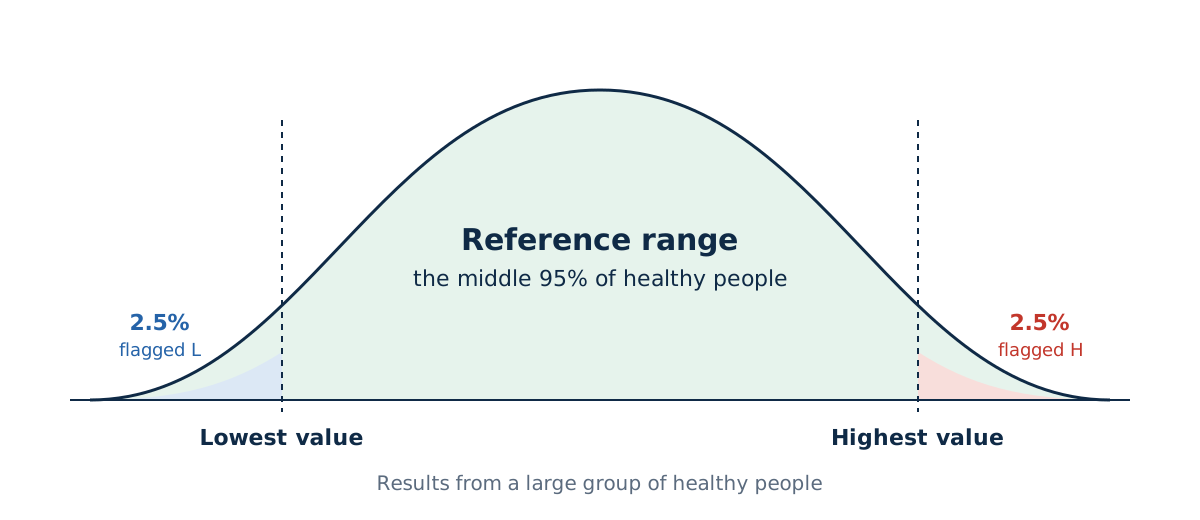
Two things follow from this:
- Being slightly outside the range is common in healthy people. If you have 20 independent tests, the chance that at least one is flagged is about 64%, even if you are completely well.
- Being inside the range does not always mean all is well. A result can be “normal” for the population but unusual for you, for example a haemoglobin that has dropped from 14 to 12 g/dL in a year.
Ranges also differ between labs, because they use different machines, methods and reference groups. That is why you should always compare your result with the range printed on your own report, not with a chart from the internet. Try it with the tool below.
Where does your result sit in the range?
LBelow the range
6.7% below the lowest value of the range. A result just outside the range is common and often not significant on its own; your doctor will read it with your symptoms and other results.
Type the range printed next to your result: it differs between labs, ages and sexes, and your lab's range is the one that counts. The preset ranges are typical adult values. This runs in your browser and nothing is stored. How reference ranges work
Some tests use a target or decision limit instead of a population range. For example, cholesterol and HbA1c are judged against levels linked to heart disease or diabetes, not against what is common, because many “typical” Indian adults have values that are already too high.
H, L and critical flags
- H means the result is above the reference range; L means it is below.
- Some labs use *, bold type or colour instead.
- A critical or panic value is a result far enough outside the range to need prompt attention, such as a very high potassium or very low sodium. Accredited labs usually phone the doctor or patient about these. If a lab calls you about a critical result, act on it the same day.
How far outside the range a result is matters more than the flag itself. A haemoglobin of 11.8 with a range starting at 12 is very different from a haemoglobin of 7.
Units and conversions
Most Indian labs report in conventional units such as mg/dL. Reports from abroad, and some apps, use SI units such as mmol/L. Never compare numbers in different units without converting them:
| Test | Common Indian unit | Other unit | How to convert |
|---|---|---|---|
| Glucose | mg/dL | mmol/L | mmol/L × 18 = mg/dL |
| Total, LDL or HDL cholesterol | mg/dL | mmol/L | mmol/L × 38.67 = mg/dL |
| Triglycerides | mg/dL | mmol/L | mmol/L × 88.57 = mg/dL |
| Creatinine | mg/dL | µmol/L | µmol/L ÷ 88.4 = mg/dL |
| Haemoglobin | g/dL | g/L | g/L ÷ 10 = g/dL |
| Vitamin D (25-OH) | ng/mL | nmol/L | nmol/L ÷ 2.5 = ng/mL |
| Vitamin B12 | pg/mL | pmol/L | pmol/L × 1.355 = pg/mL |
Counts are also written in different ways. A platelet count of 2.5 lakh, 250,000/µL, 250 × 10³/µL and 250 × 10⁹/L all mean the same thing.
Common test panels and what they check
| Panel | What it looks at |
|---|---|
| CBC (complete blood count) | Red cells and haemoglobin (anaemia), white cells (infection, inflammation), platelets (clotting) |
| Blood sugar: fasting, post-meal, HbA1c | Diabetes and prediabetes |
| Lipid profile | Cholesterol and triglycerides, for heart risk |
| LFT (liver function tests) | Liver enzymes (SGPT/ALT, SGOT/AST), bilirubin, proteins |
| KFT or RFT (kidney function tests) | Creatinine, urea, eGFR, electrolytes |
| Thyroid profile | TSH, T3, T4 |
| Urine routine | Sugar, protein, blood, infection |
| Vitamins and iron | Vitamin B12, vitamin D, ferritin and iron studies |
What can change a result
- Fasting and meals: glucose and triglycerides rise after food. Ask the lab whether you need to fast. Most cholesterol tests do not need fasting, according to European laboratory and heart societies.
- Exercise: hard exercise in the day or two before a test can raise muscle enzymes (CK, SGOT) and sometimes creatinine.
- Dehydration can raise haemoglobin, urea and creatinine.
- Time of day: cortisol, iron and some hormones vary through the day.
- Menstrual cycle and pregnancy change many hormone and blood count values.
- Medicines and supplements: biotin (vitamin B7), common in hair and nail supplements, can make thyroid, hormone and heart tests falsely high or low, according to the US FDA. Tell the lab about any supplements.
- Sample problems: a sample that clotted, was haemolysed (red cells broke open) or waited too long can give false results, especially for potassium and platelets. Labs usually note this in the comments.
Comparing reports over time
A single result is a snapshot. The trend is often more useful. If you can, use the same lab for repeat tests, keep your reports in one folder, and look at how each value has moved. A steady change within the range can matter more than a one-off flag just outside it.
In India, check that your lab is accredited by the National Accreditation Board for Testing and Calibration Laboratories (NABL) to ISO 15189, which covers quality control and how reports are issued.
What to do next
- Do not start, stop or change any medicine because of a report. Discuss it with your doctor first.
- If a result is only slightly out of range and you feel well, your doctor may simply repeat it.
- Take all your reports, old and new, to the appointment, and write down any symptoms.
- Avoid ordering more tests to “double-check” on your own. Each extra test adds another chance of a false alarm.
When to get help quickly
- The lab phones you about a critical result.
- Your report is abnormal and you have chest pain, breathlessness, fainting, confusion, bleeding, black stools or a high fever.
- In an emergency, call 112.
Questions to ask your doctor
- Which results matter most for me, and why?
- Is this result new, or has it been like this before?
- Could my medicines, supplements or a recent illness explain it?
- Does it need repeating, and when?
Frequently asked questions
What does the reference range on a blood test report mean?
It is the range in which about 95% of healthy people's results fall, as set by the lab. Results slightly outside it are common in healthy people, and ranges differ between labs, so always use the range printed on your own report.
What do H and L mean on a lab report?
H means the result is above the lab's reference range and L means it is below. A flag is not a diagnosis; how far outside the range the result is, and your symptoms, matter more.
Is one abnormal value in a blood test a problem?
Often not. With many tests, most healthy people have at least one result slightly outside the range. Your doctor may repeat it or look at it with your other results and symptoms.
Do I need to fast for a blood test?
It depends on the test. Fasting is usually needed for fasting glucose and sometimes for triglycerides, but not for most cholesterol tests, a CBC or thyroid tests. Ask the lab when you book.
Why are my results different at two labs?
Labs use different machines, methods and reference ranges, and results also vary naturally from day to day. Compare each result with that lab's own range, and use the same lab for repeat tests when you can.
Sources
- Ozarda Y. Reference intervals: current status, recent developments and future considerations. Biochem Med (Zagreb) 2016;26(1):5–16.
- Nordestgaard BG, et al. Fasting is not routinely required for determination of a lipid profile: a joint consensus statement from the European Atherosclerosis Society and European Federation of Clinical Chemistry and Laboratory Medicine. Eur Heart J 2016;37(25):1944–1958.
- US Food and Drug Administration. Biotin (vitamin B7) may interfere with lab tests: safety communication.
- National Accreditation Board for Testing and Calibration Laboratories (NABL). Accreditation of medical laboratories to ISO 15189.
This article is general information for adults in India and is not a diagnosis or a treatment plan. Always discuss results and any changes with your own doctor. Read our editorial policy.